
The True Cost of Being Uninsured: Real STR Claim Scenarios and What They Cost
Every week, vacation rental owners across America receive letters denying claims worth tens of thousands of dollars. The reason is almost always the same — and almost always avoidable.
There is a quiet financial crisis unfolding in the short-term rental (STR) industry, and most hosts don’t know it’s happening until it’s too late. Property owners are running a commercial hospitality business under a residential insurance policy, and their insurers are exercising the legal right to deny coverage for business activities.
According to a March 2026 report from the Insurance Information Institute (Triple-I), standard homeowners insurance “typically does not cover the full range of risks” associated with operating a short-term rental, and the report explicitly classifies STR activity as a “commercial exposure” under most homeowners policies. That single classification is the legal foundation that allows insurance companies to walk away from your claim — leaving you holding a bill that can reach six or even seven figures.
In this guide, we are going to be brutally honest about what an uninsured vacation rental loss actually looks like: how much a denied STR claim really costs, and what the difference between a proper commercial policy and a standard homeowners policy means in real dollars.
The Scale of the STR Underinsurance Problem
The short-term rental industry has exploded over the past decade. Airbnb alone reports over 9 million active listings worldwide and has facilitated over 2 billion guest arrivals. In the United States, the STR market is projected to reach $22 billion in 2026, growing at a compound annual growth rate of 7.3% through 2033.
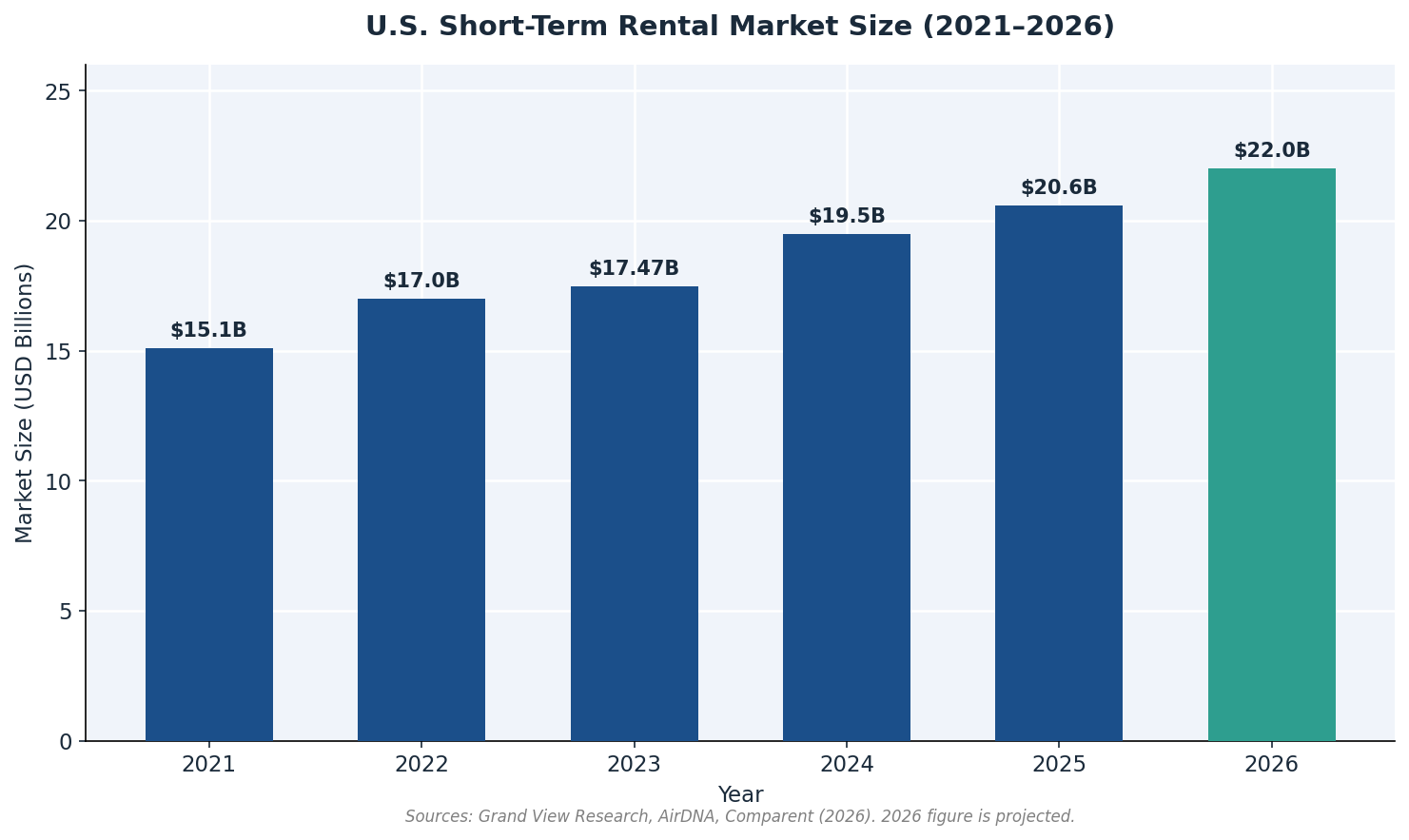
Yet despite this massive growth, a significant portion of hosts remain dangerously underinsured. A 2025 report from Steadily, a leading STR insurance provider, estimated that nearly 40% of Airbnb hosts are underinsured or completely unprotected. That represents hundreds of thousands of property owners who are one bad guest, one burst pipe, or one slip-and-fall lawsuit away from financial catastrophe.
The Illusion of Coverage: Why Standard Homeowners Policies Fail STR Hosts
To understand the homeowners insurance STR exclusion, you have to understand how insurance companies think about risk. A standard homeowners policy (HO-3 or HO-5) is designed for a single-family owner-occupied residence. The underwriter prices the policy based on the assumption that the homeowner is living in the property, maintaining it carefully, and not inviting strangers to pay to stay there.
When you list your property on Airbnb or Vrbo, you fundamentally change the risk profile. You are now operating a transient occupancy business. You have no control over who enters your home, how carefully they treat it, or what activities they engage in. From the insurance company’s perspective, this is a commercial risk — not a residential one.
The “business pursuits exclusion” is a standard clause in virtually every homeowners insurance policy in the United States. It states, in plain terms, that the policy does not cover bodily injury or property damage arising out of business activities conducted on the premises. When your guest is a paying customer, their stay is a business activity. If they get hurt, the exclusion applies.
The Problem With AirCover and Platform Guarantees
Airbnb’s AirCover program is marketed aggressively as a safety net — $3 million in “Host Damage Protection” and $1 million in “Host Liability Insurance.” On the surface, that sounds comprehensive. In practice, it is riddled with limitations that leave hosts exposed to an AirCover denied claim scenario.
- AirCover is not an insurance policy in most states. It is a contractual guarantee from Airbnb, meaning Airbnb itself decides whether to pay your claim. There is no independent insurance regulator overseeing the process, and no appeals process through your state’s Department of Insurance.
- AirCover only covers Airbnb bookings. Direct bookings, Vrbo reservations, and Booking.com stays get zero coverage. As direct bookings continue to surge — growing by over 340% year-over-year among some host groups in 2025 — this gap is increasingly dangerous.
- The claims process is notoriously difficult. Hosts must document damage within 72 hours of checkout, provide photographic evidence, and submit through Airbnb’s internal resolution system. Airbnb has final say on all payouts, and many hosts report receiving 20–40 cents on the dollar.
Vrbo’s Host Liability Program has similar limitations: $1 million in liability, but only for Vrbo bookings, and only when the host has not purchased their own commercial insurance.
Real-World Claim Scenarios: The Numbers Don't Lie
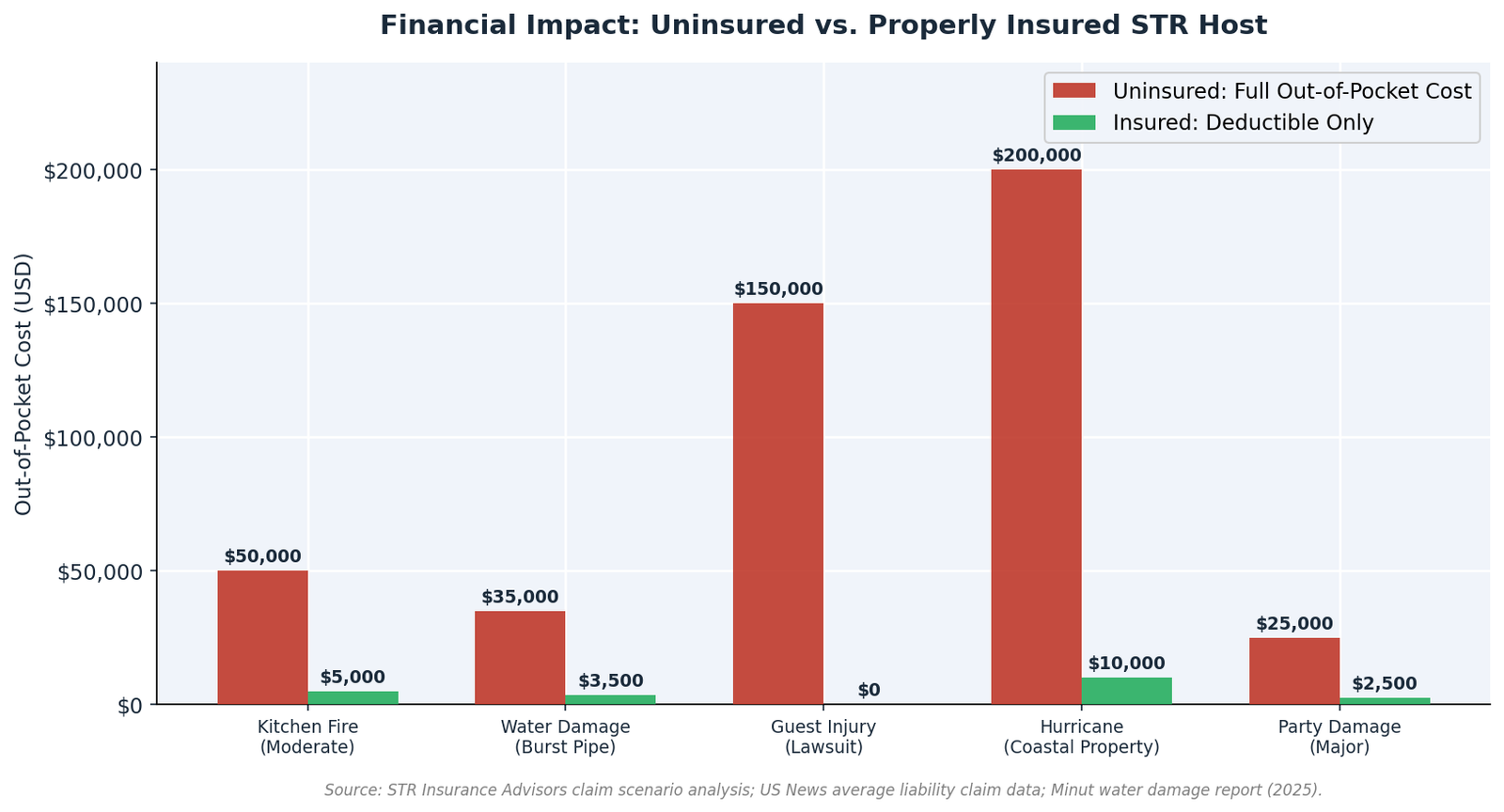
The most powerful way to understand an uninsured vacation rental loss is to look at real claim scenarios. The following examples are based on actual claim types and average settlement data from the insurance industry.
Scenario 1: The Catastrophic Water Damage Event
Water damage is the most common and one of the most financially devastating claims in real estate. According to the EPA, water damage and freezing account for nearly one in five home insurance claims, costing U.S. property owners over $13 billion annually. In an STR — where guests rarely report minor leaks and properties sit vacant between bookings — the risk is significantly elevated.
The Scenario: A pipe in the upstairs bathroom of your three-bedroom Smoky Mountain STR cabin freezes and bursts during a January cold snap while the property is vacant. The water runs for 48 hours before your cleaner discovers it. The first floor is flooded, hardwoods destroyed, drywall saturated, mold already forming.
| Expense | Uninsured Cost |
|---|---|
| Emergency plumbing repair | $3,500 |
| Water extraction and structural drying | $8,000 |
| Mold testing and remediation | $6,500 |
| Hardwood floor replacement (1,200 sq ft) | $12,000 |
| Drywall repair and repainting | $7,500 |
| Lost rental income (8 weeks at $3,000/week) | $24,000 |
| Total Out-of-Pocket Cost | $61,500 |
With a Standard Homeowners Policy: The insurer discovers the property is used as an STR and denies the claim under the business pursuits exclusion. You pay $61,500 out of pocket.
With a Commercial STR Policy: You pay your deductible (e.g., $3,500). The policy covers the $58,000 in repairs and reimburses the $24,000 in lost business income under “Actual Loss Sustained.”
Scenario 2: The Guest Liability Lawsuit
Liability claims are the most existentially threatening risk for any STR host. The average liability claim in the U.S. costs approximately $29,880, but severe injuries — spinal cord damage, traumatic brain injuries, drownings — routinely settle in the hundreds of thousands or millions.
A Virginia family was awarded a $1.3 million settlement in a wrongful death lawsuit involving an Airbnb property in 2024. Another premises liability case tied to a vacation rental resulted in a $2.7 million settlement. These are the inevitable consequence of operating a transient occupancy business without adequate commercial liability coverage — the textbook short term rental liability lawsuit cost scenario.
The Scenario: A guest at your beachfront Florida STR slips on a wet tile surface near the pool and suffers a severe spinal injury. They are partially paralyzed, require long-term care, and file a $2 million lawsuit.
| Expense | Uninsured Cost |
|---|---|
| Legal defense attorney fees | $75,000 |
| Expert witness fees | $25,000 |
| Medical bill reimbursement | $400,000 |
| Pain and suffering settlement | $1,000,000 |
| Lost wages reimbursement | $200,000 |
| Total Lawsuit Cost | $1,700,000 |
With a Standard Homeowners Policy: The insurer denies defense and indemnification because the injury occurred during a commercial activity. You are personally liable for $1.7M. If you can’t pay, the plaintiff can pursue your primary home, retirement accounts, and savings.
With a Commercial STR Policy ($2M CGL): The policy immediately assigns a defense attorney at no cost to you outside the policy limit, then pays the settlement up to $2M. Your personal assets are completely protected.
Scenario 3: The Unauthorized Party and Major Property Damage
Despite the best screening tools and strictest house rules, unauthorized parties happen. A guest books your Nashville STR for a “family gathering” and invites 50 people. The party results in broken furniture, smashed appliances, a destroyed TV, stained carpets, and significant wall and door damage.
| Expense | Uninsured Cost |
|---|---|
| Furniture replacement (living room set, dining table) | $8,500 |
| Electronics replacement (65″ TV, soundbar) | $3,200 |
| Carpet replacement (entire first floor) | $6,000 |
| Drywall repair and repainting | $4,500 |
| Door and lock replacement | $1,800 |
| Deep cleaning and odor remediation | $1,500 |
| Total Property Damage | $25,500 |
With AirCover: Airbnb’s resolution team may offer a fraction of the actual cost, citing “insufficient documentation” or “normal wear and tear.” Many hosts receive 20–40 cents on the dollar.
With a Commercial STR Policy: Full $25,500 in guest-caused damage covered at Replacement Cost Value, no sublimits. You pay your deductible and receive a check for the remainder.
Scenario 4: The Kitchen Fire
Kitchen fires are among the most severe property damage events in the STR industry. Guests unfamiliar with the property’s appliances leave food unattended; a grease fire spreads to the cabinets and ceiling. The fire is extinguished before total loss, but the kitchen is destroyed.
| Expense | Uninsured Cost |
|---|---|
| Kitchen demolition and rebuild | $35,000 |
| Smoke damage remediation (entire home) | $12,000 |
| New appliances | $8,000 |
| Lost rental income (10 weeks) | $20,000 |
| Total Out-of-Pocket Cost | $75,000 |
With a Standard Homeowners Policy: Denied under the business pursuits exclusion. You pay $75,000 out of pocket.
With a Commercial STR Policy: You pay your deductible. The policy covers the full rebuild, smoke remediation, appliance replacement, and lost business income.
The Hidden Costs That Compound an Uninsured Vacation Rental Loss
Beyond the immediate financial impact of a denied claim, being underinsured carries several compounding costs that erode your business over time.
Actual Cash Value vs. Replacement Cost Value
Many hosts who do have some form of insurance are shocked to discover that their policy pays “Actual Cash Value” (ACV) rather than “Replacement Cost Value” (RCV). ACV is the depreciated value of the damaged item — what it is worth today, not what it costs to replace. A five-year-old couch that cost $1,500 might have an ACV of $300. An RCV policy pays you the $1,500 it costs to buy a new couch of similar quality.
Over a portfolio of 3–5 properties, the difference between ACV and RCV payouts can amount to tens of thousands of dollars per year. Always verify that your policy provides RCV for both the dwelling and its contents.
Loss of Business Income: The Revenue Killer
Standard homeowners policies do not include “Loss of Business Income” coverage. When a covered peril renders your property uninhabitable, you lose your rental revenue while the home is being repaired. For a high-performing STR generating $5,000/month, a three-month repair timeline means $15,000 in lost income. For a Smoky Mountain cabin generating $8,000/month, that same three-month downtime costs $24,000.
A commercial STR policy includes “Actual Loss Sustained” coverage, which reimburses you based on your historical booking data and confirmed future reservations.
The Mortgage Trap
If you are carrying a mortgage on your STR, losing rental income while the property is being repaired can push you into default. You still owe the monthly mortgage payment regardless of whether the property is generating revenue. A commercial policy with Loss of Business Income coverage ensures cash flow to service the debt while the property is offline.
Liability Sublimits: The Fine Print Trap
Some policies advertise $1 million in liability coverage but hide sublimits in the fine print — e.g., capping payouts at $50,000 for injuries related to a hot tub or swimming pool. If a pool-related lawsuit settles for $300,000, you are responsible for the remaining $250,000. Always read the declarations page carefully and ask your broker specifically about sublimits for your property’s amenities.
What a Proper Commercial STR Policy Looks Like
A comprehensive commercial short-term rental policy should include all of the following:
| Coverage Component | What It Protects | Min. Recommended Limit |
|---|---|---|
| Commercial General Liability (CGL) | Bodily injury & property damage to guests and third parties | $1,000,000 per occurrence |
| Dwelling / Building Coverage | Physical structure of the property | Full Replacement Cost Value |
| Contents Coverage | All furnishings, appliances, personal property | Full RCV, no sublimits |
| Loss of Business Income | Revenue lost while uninhabitable | Actual Loss Sustained (12 mo min) |
| Medical Payments | Minor guest injuries without a lawsuit | $5,000 – $10,000 |
| Flood Insurance (separate policy) | Flood damage from storm surge or heavy rain | $250,000+ (private policy) |
The Cost of Proper Coverage vs. the Cost of Being Uninsured
The most common objection to purchasing a commercial STR policy is the cost. A standard homeowners policy might cost $1,200 per year, while a commercial STR policy might cost $2,000–$4,000 per year depending on the property. The additional premium feels significant.
But consider this: a single denied liability claim can cost $1.7 million. A single denied water damage claim can cost $61,500. Against those numbers, the additional annual premium is not a cost — it is the best investment you will ever make in your STR business.
Furthermore, as we explain in our STR insurance tax deduction guide, your commercial STR insurance premium is fully deductible as a business expense under IRS Publication 527. If you are in the 24% federal tax bracket, a $3,000 commercial premium effectively costs you $2,280 after the deduction — less than $7 per day to protect a $500,000 asset and your personal financial future.
Conclusion: The Only Acceptable Risk Is a Calculated One
Running a short-term rental business means accepting a certain level of risk. Guests will damage things. Pipes will burst. Accidents will happen. The question is not whether a claim will occur — it is whether your insurance will pay for it when it does.
Operating under a standard homeowners policy or relying on platform guarantees is not a calculated risk. It is a blind gamble with your financial future. The Insurance Information Institute has made it clear: short-term rental activity is a commercial exposure, and it requires commercial insurance.
For a complete framework, read our companion guides on STR risk management with LLCs and umbrella policies and when to get STR insurance during your buying timeline.
Get a free commercial STR policy review.
STR Insurance Advisors specializes in closing every dangerous gap in your coverage — before a claim, not after.
References
- Insurance Information Institute (Triple-I). “Short-Term Rentals and Homeowners Insurance Outlook.” March 2026.
- Airbnb. “About Us.” 2026.
- Grand View Research / StayFi. “Vacation Rental Statistics, Data, Trends in 2026.” April 2026.
- Steadily. “Airbnb Host Insurance Statistics.” May 2025.
- Florida Rental By Owners. “Annual Florida Vacation Rental Report 2025.”
- Minut. “The hidden cost of water damage in vacation rentals.” May 12, 2025.
- U.S. News & World Report. “Most Common Homeowners Insurance Claims.”
- First Coast News. “Family awarded $1.3 million in drowning settlement with Airbnb.” May 18, 2024.
- Carolina Accident Attorneys. “Vacation Rental Premises Liability Settlement.”