Smoky Mountain cabin insurance is the single most important investment a Gatlinburg or Pigeon Forge host can make. Premium cabins generate $80K–$200K+ annually, but the wildfire, hot tub, and steep-terrain risks they face will destroy a standard homeowners policy on the very first claim.
Smoky Mountain cabin insurance sits at the intersection of three high-risk worlds: wildfire-prone terrain, high-amenity properties, and one of the highest-grossing STR markets in the United States. Gatlinburg, Pigeon Forge, and the surrounding communities in Sevier County, Tennessee, attract over 14 million visitors annually, making the Smokies the most visited national park in the country.
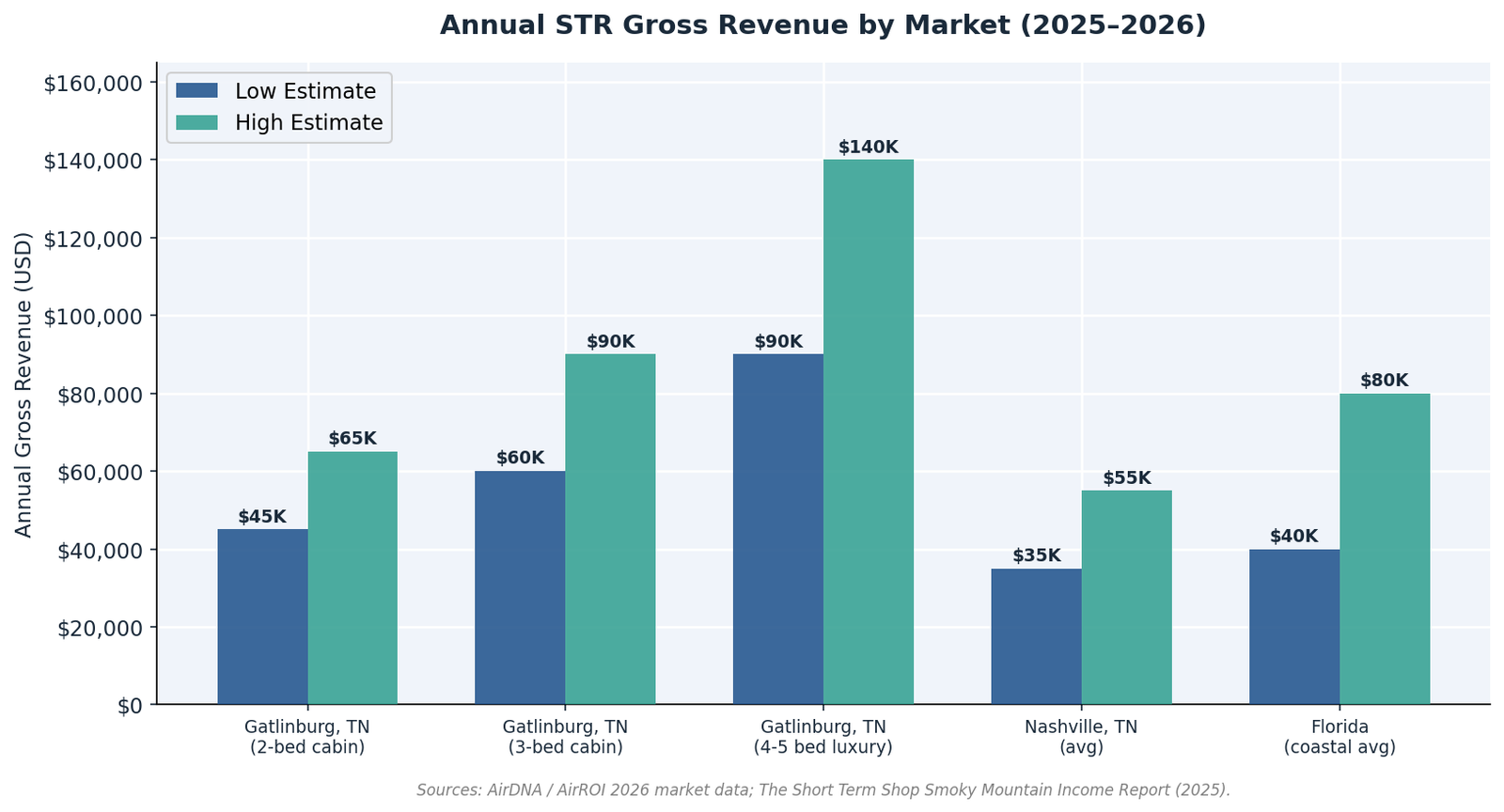
For property investors, the numbers are extraordinary. A well-positioned cabin in the Gatlinburg market can generate $80,000 to $150,000 or more in gross annual revenue. Some premium properties push well beyond $200,000 per year. With that kind of revenue potential, the Smoky Mountain STR market has become intensely competitive.
Thousands of investors have poured capital into the region. Properties range from cozy one-bedroom hideaways to sprawling eight-bedroom luxury lodges with private theaters, indoor pools, and arcade rooms. But with high revenue comes high risk, and the insurance challenges facing Gatlinburg STR insurance buyers and Pigeon Forge vacation rental insurance customers are uniquely difficult.
In this guide, we cover everything you need to know about Smoky Mountain cabin insurance — from the specific perils that threaten mountain properties to the coverage structures that protect high-revenue vacation rental businesses.
The Smoky Mountains present a combination of environmental, structural, and operational risks that make standard insurance products entirely inadequate.
Understanding these risks is the first step toward building a proper Smoky Mountain cabin insurance strategy. Below are the four core risk categories every Gatlinburg or Pigeon Forge host must address.
On November 28, 2016, a wind-driven wildfire swept through Gatlinburg, killing 14 people and destroying over 2,400 structures. The Chimney Tops 2 fire caused an estimated $500 million in property damage.
That single event fundamentally changed how the insurance industry views the Smoky Mountain region. According to the National Park Service, the fire spread across more than 17,000 acres in days.
The wildfire risk in the Smokies is not theoretical. It is a documented, recurring threat. Steep terrain, dense forest, and occasional drought create a fire environment that can escalate rapidly.
For cabin owners, wildfire must be treated as a primary peril, not an afterthought. A comprehensive Smoky Mountain cabin insurance policy must include broad “all-risk” or “open perils” coverage that explicitly includes wildfire.
Some carriers have begun to exclude wildfire or add significant wildfire sublimits in high-risk areas. Before binding any policy, confirm in writing that wildfire is a covered peril with no sublimit.
Hot tubs are the single most important amenity in the Smoky Mountain STR market. A cabin without a hot tub is at a significant competitive disadvantage.
However, hot tubs are also one of the leading sources of liability claims in the vacation rental industry. This makes hot tub liability insurance STR coverage non-negotiable.
Slip-and-fall accidents on wet decks, drowning incidents, and injuries caused by improperly maintained water chemistry are all common claim types. A single severe hot tub injury lawsuit can easily reach $500,000 or more.
The critical issue is that many policies contain sublimits for “water feature” liability. A policy might advertise $1 million in liability coverage but cap hot tub-related injuries at $100,000.
If a guest is severely injured in your hot tub and the lawsuit settles for $400,000, you are personally responsible for the $300,000 gap.
When purchasing Smoky Mountain cabin insurance, explicitly verify that your policy provides full, unreduced liability coverage for hot tubs, outdoor pools, and any other water features.
Many of the most desirable Smoky Mountain cabins are built on steep hillsides, offering dramatic mountain views. This terrain creates three unique structural risks every host must address.
A Smoky Mountain cabin generating $120,000 per year in gross revenue has a very different insurance need than a suburban Airbnb generating $30,000 per year.
If a wildfire or severe water damage event takes your cabin offline for six months, you lose $60,000 in revenue — not $15,000.
Your Smoky Mountain cabin insurance policy must include “Actual Loss Sustained” coverage with a limit that reflects your actual annual revenue. Many hosts accept the default Loss of Business Income limit offered by the carrier, which may be far too low for a high-performing mountain cabin.
To properly size your Smoky Mountain cabin insurance coverage, you need to understand the revenue potential of the market.
The following data, sourced from AirDNA’s 2025 market analysis, illustrates the revenue landscape across key Smoky Mountain markets.
| Market | Avg Annual Revenue (2025) | Avg Daily Rate | Avg Occupancy |
|---|---|---|---|
| Gatlinburg, TN | $68,400 | $267 | 70% |
| Pigeon Forge, TN | $54,200 | $211 | 70% |
| Sevierville, TN | $47,800 | $186 | 70% |
| Wears Valley, TN | $58,600 | $228 | 70% |
Source: AirDNA 2025 Market Analysis
These figures represent averages across all property sizes and types. Premium cabins with luxury amenities routinely generate 2–3x the average revenue.
For these high-performing properties, the Smoky Mountain cabin insurance Loss of Business Income limit must be sized accordingly.
Tennessee has a relatively permissive regulatory environment for short-term rentals at the state level. But local municipalities in the Smoky Mountain region have implemented their own rules.
This is a key part of any Tennessee short term rental insurance conversation. See the Tennessee Department of Revenue STR guidance for the latest state-level rules.
Sevier County: Requires STR operators to obtain a county business license and collect and remit the local occupancy tax. While there is no explicit state-mandated insurance minimum, many property management agreements and lender requirements mandate commercial liability coverage.
Gatlinburg: The city of Gatlinburg requires a business license for STR operations and has been actively discussing permit caps and zoning restrictions. Hosts operating in the city limits should monitor local ordinances closely.
Pigeon Forge: Similar to Gatlinburg, Pigeon Forge requires a business license and has implemented specific safety requirements for STR properties, including smoke detector and fire extinguisher mandates.
Regardless of local requirements, operating a high-revenue cabin without proper Smoky Mountain cabin insurance is financial negligence. A single liability lawsuit can exceed the annual revenue of the property many times over.
Based on the unique risks of the region, a Smoky Mountain cabin insurance policy should be structured across five core coverage areas. Each one closes a gap that a standard homeowners policy will leave wide open.
Over years of working with STR investors in the Smoky Mountains, we have identified four recurring mistakes that leave hosts dangerously exposed.
Mistake 1: Relying on a Standard Homeowners Policy. Many investors purchase a Smoky Mountain cabin as a second home and simply add it to their existing homeowners insurance. The moment they list it on Airbnb, they are operating a commercial business under a residential policy. Any claim arising from a paying guest will be denied. The Insurance Information Institute confirms STR activity as a commercial exposure.
Mistake 2: Accepting the Default Loss of Business Income Limit. Insurance carriers often set a default Loss of Business Income limit that is far too low for high-revenue properties. Always review this limit against your actual revenue projections.
Mistake 3: Not Disclosing All Amenities. If you add a hot tub, fire pit, or swimming pool after the policy is written, you must notify your insurance carrier. Failing to disclose new amenities can void your coverage for related claims.
Mistake 4: Assuming AirCover Covers Mountain Cabins. AirCover’s Host Liability Insurance has the same limitations in the Smokies as everywhere else. It only covers Airbnb bookings, it is not a standalone insurance policy, and it cannot satisfy lender or permit requirements.
The Smoky Mountain region offers some of the most compelling STR investment opportunities in the United States. But the unique combination of wildfire risk, high-liability amenities, and steep terrain demands a sophisticated insurance strategy.
A standard homeowners policy or a basic landlord policy will not protect your investment. Proper Smoky Mountain cabin insurance is the only path forward.
For deeper context, read our companion guides on the true cost of being uninsured, water damage and fire risks that destroy vacation rental businesses, and when to get STR insurance during your buying timeline.
Work with a specialized STR insurance broker who understands the specific risks of the Smoky Mountain market. At STR Insurance Advisors, we have deep expertise in insuring mountain cabins and can structure a commercial policy that covers every peril specific to your property.
STR Insurance Advisors structures policies that cover every peril specific to Smoky Mountain cabins — wildfire, hot tub liability, and high revenue loss.